Menu




Menu



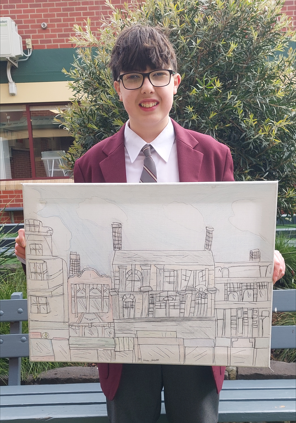
My name is Leon Foukis and I am in Year 8.
I enjoy drawing and making art and have been attending art classes on and off since I was in Year 6.
One of the teachers at Oakleigh Grammar, asked me to make her an artwork for her wall. As she is Welsh, I thought to draw the capital city in Wales - Cardiff. I enjoy drawing in an abstract style and using colour for effect. I also enjoy drawing portraits and sketching figures.
I have my drawings on display in cafés in Blackburn and Doncaster. I have enjoyed connecting with the social media managers of these businesses to discuss displaying my artwork.
I look forward to making more art and seeing my work hanging up at Oakleigh Grammar.
Some of you may have read recent news reports highlighting concerns about Australia’s performance in PISA 2025.
PISA, the OECD’s Programme for International Student Assessment, is a major international study that assesses the knowledge, skills and attitudes of 15-year-old students, including how well they can apply what they have learned to complex problems. In 2025, more than 760,000 students across 91 countries and economies participated, including 14,658 Australian students from 766 schools.
There are certainly challenges. Australia’s reading and mathematics performance has continued a longer-term decline.
However, there is also some good news.
Australian students remain above the OECD average in science, reading and mathematics. Australian students showed some positive attitudes towards learning as well: 69.8% said they like learning new things at school, and 79.5% said they like to know how things work.
Another encouraging finding is the support students report receiving from teachers. In Australia, 79% said their science teachers show an interest in every student’s learning, 73% said teachers continue teaching until students understand, and 80% said teachers provide extra help when needed, all above OECD averages.
But PISA also highlights something particularly relevant to us as parents: day-to-day family support. Importantly, this is different from formal parent involvement in school.
PISA’s family-support measure looks at everyday actions such as taking an interest in what children are learning, asking what they did at school, discussing how well they are doing, talking about problems at school, and discussing their future education.
Across countries, stronger family support was associated with better science performance and more positive attitudes towards learning. Particularly interesting was the importance of parents showing an interest in their children’s day-to-day learning.
In Australia, however, some of these everyday conversations are becoming less common. In 2022, 81% of Australian students said a parent or guardian asked what they had done at school at least once a week; by 2025, this had fallen to 75%. Weekly conversations about problems at school fell from 54% to 44%.
The message for families is simple: supporting learning does not mean becoming your child’s teacher.
Regularly asking “What did you learn today?”, “What was challenging?” or “How did you work through it?” can communicate a powerful message: Your learning matters to us.
Guang Wu
MYP Coordinator